Laban Tall
Far from the Madding CrowdLaban Tall is a Weatherbury farmworker whose importance lies less in individual authority than in the steady, practical part he plays within the village community. He helps respond to Fanny Robin’s disappearance, becomes a cautious voice amid rumors that Sergeant Troy has returned, and carries the news that Boldwood will not be executed. Across these episodes, his conduct shows how village life depends on shared information, local trust, and decisions about when speaking may help or harm.
Identity and Place in the Community
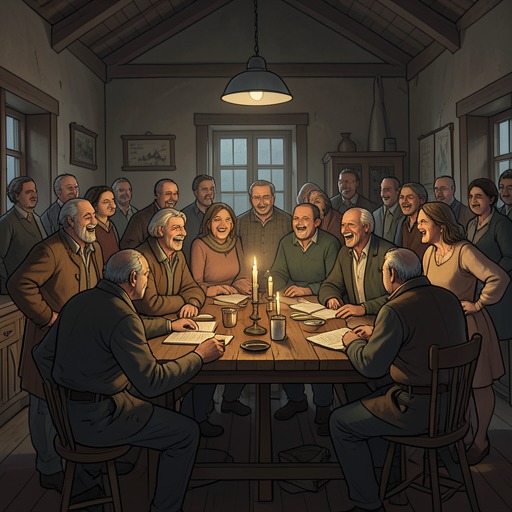
The narrative identifies Tall as one of the farmworkers around Bathsheba’s household and as a man whose voice and judgment are recognized by his companions. During the gathering outside Boldwood’s house, his fellow workers recognize him by his voice and describe Bathsheba as having always treated him fairly. Tall, in turn, speaks warmly of her honesty and bravery, while acknowledging that she can be hot-tempered. His standing rests on personal familiarity rather than formal power: he knows the people involved, but is not always willing to intervene in their affairs.
Responding to Fanny Robin’s Disappearance
When Fanny Robin’s absence alarms Bathsheba, the household’s workers are asked to make quiet inquiries in nearby villages. Maryann reports that Fanny had a bundle and that the man she was connected to lived in Casterbridge and was believed to be a soldier, though she did not know his name. The episode establishes the uncertainty facing the farm community: Fanny has left without a bonnet, and even those who worked alongside her have little reliable information about her private life. Tall’s later conduct in the novel’s crises belongs to the same world of rumor and incomplete knowledge, where the workers’ first responsibility is to decide what can safely be said or done.
Rumors of Troy’s Return
On the night of the gathering at Boldwood’s house, Tall joins the farmworkers discussing a report that Troy has been seen in Casterbridge. The men fear the report may be true, but they also recognize that Bathsheba knows nothing of it. Tall counsels silence: repeating an unconfirmed story could distress her, while warning her in advance would do no good if Troy has indeed returned. His reasoning is measured and compassionate, grounded in the risk that information itself could cause harm before anyone can act on it.
Tall also defends Bathsheba against the workers who suggest that her suffering is deserved because she became involved with Troy. He insists that she was young and could not have known what kind of man Troy was. He calls her brave and says she has never been false to him; the others agree that she speaks plainly rather than acting underhandedly. Their conversation makes Tall a representative of the village’s moral judgment at a moment when Bathsheba is absent from the discussion and cannot speak for herself.
When the group decides that someone should warn Bathsheba, Tall is reluctant. He says he is not fit to approach Boldwood and proposes that William Smallbury should act instead. The others redirect the task: Tall should try to speak to Bathsheba, not Boldwood. Yet, once inside, Tall cannot bring himself to interrupt the gathering and its efforts to enliven a strained party. He returns without delivering the warning. The hesitation is not indifference: he is caught between the workers’ sense that Bathsheba should know and his reluctance to disturb her at a difficult moment. His failure to speak underscores the limits of communal concern when there is no clearly safe way to act.
A Messenger at a Moment of Suspense
Later, when the villagers await word about Boldwood’s fate, Tall is entrusted with a more definite task. Gabriel Oak arranges for him to ride to Casterbridge late at night and wait for news; if nothing arrives by eleven, the villagers understand that there is little hope of a reprieve. Tall carries out the errand and returns to the waiting group with the decisive message: Boldwood is not to die, but will be confined during the Crown’s pleasure. His report resolves the immediate uncertainty and brings relief to the villagers, even as Oak’s feelings remain divided by his belief that Boldwood had qualities worth loving and his sense that he ought to die.
Tall’s role here contrasts with his earlier hesitation at Boldwood’s party. In the first crisis he cannot find a way to deliver a warning; in the later one he carries a clear, requested message that the whole community needs. The difference is not a transformation into a public leader, but a shift in the kind of action demanded of him: discretion when the truth is uncertain, dependable service when the outcome has been officially decided.
Work, Trust, and the Novel’s Ending
In the final preparations for Bathsheba and Gabriel Oak’s marriage, Jan Coggan and Oak go to Tall’s home intending to summon him discreetly. They plan to tell him to meet Bathsheba near the church-hatch the following morning, dressed in his best clothes, while disguising the purpose as farm business. Tall is away at Yalbury, so his wife receives the message instead. This small episode keeps him within the network of workers whose presence and cooperation matter to the household’s ordinary arrangements, even when he is not present in person.
Tall’s recurring appearances trace the limits and value of village solidarity. He does not control the course of Bathsheba’s or Boldwood’s life, and his attempts to intervene are shaped by uncertainty, loyalty, and deference to others. Yet he helps turn private crises into shared responsibilities: the workers search for news of Fanny, debate whether Bathsheba should be warned, and gather to learn Boldwood’s fate. His practical service and candid defense of Bathsheba give the farm community a humane presence amid the novel’s reversals.